|
|
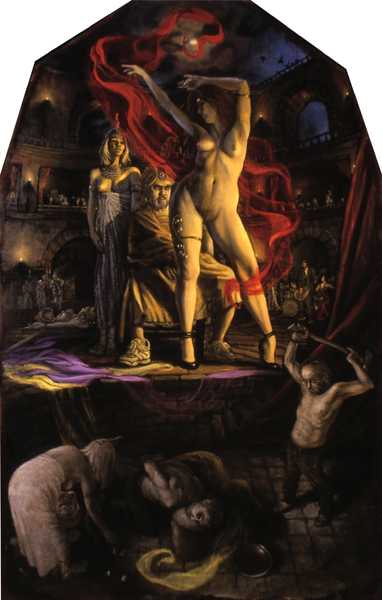
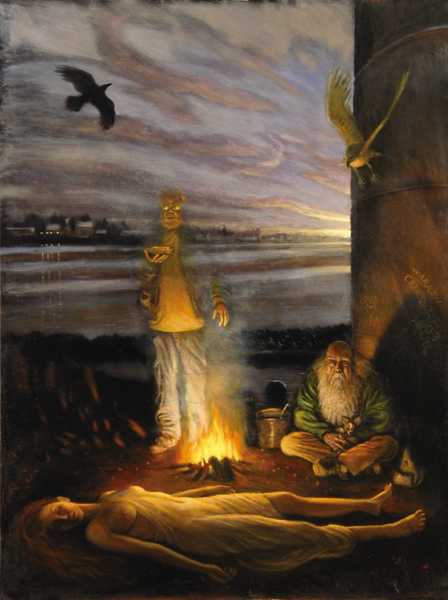
| Criswell's flair for the dramatic emerged in this new style, and he began allowing himself to address subjects far afield from the suburban and rural backyard. His love of music took strong hold of his imagery. His newfound lush, luminous realism was in fact technically and stylistically derived from the kind of painting that predominated at the moment of classical music's European apotheosis one hundred-plus years ago. Indeed, Criswell's conjurations of dark, brooding, intricate events clearly wrung from the imagination point not only at the operatic tradition of Wagner and Strauss but at the 'abstract-narrative' tradition of the tone poem, the narrative conveyed in music alone, from Beethoven through Berlioz to Liszt and the Russian Five (Rimsky-Korsakov, Borodin, etc.). Criswell's musical analogies are literalizations of extra-musical content - an old-fashioned approach given an edge of psychological and compositional destabilization that bespeaks a contemporary point of view. |
|
||||
|
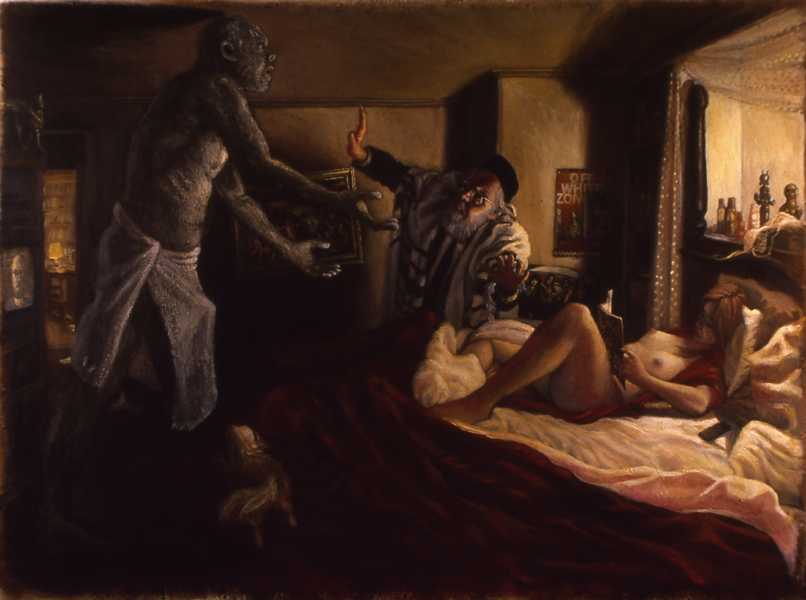
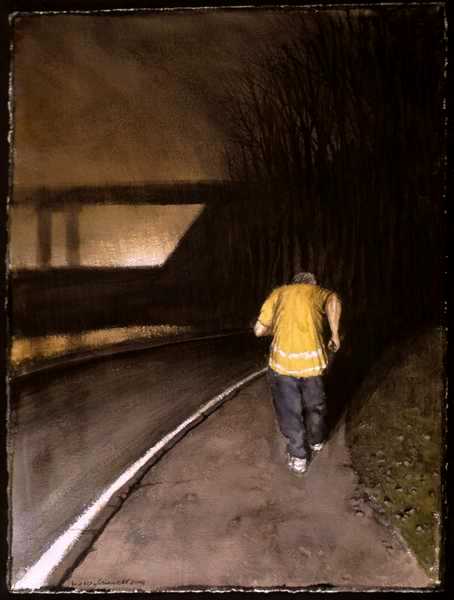
As such, Criswell's musically based pictures are not simply illustrations from libretti, nor even proposals for stage sets. They are enactments, key moments in sonic storytelling brought to a visual level. Of course these paintings, drawings and prints obviate what remains nebulous in sound; and in their attention to detail and their momentousness they clarify what is distinctive about their wholly visual media. Certainly, they recapitulate the conventions of expository fiction, epic poetry, and, as mentioned, grand opera, in media now considered inappropriate and even inadequate to the task. But the hand-rendered picture, Criswell insists, is quite adequate and appropriate. As compared to the novel, theater or film, the narrativity of painting and its attendant disciplines, no matter how retardataire, is elaborated entirely in pictorial space, not in time. Not only does painting tell a story a different way than does stage or filmwork; that way of telling provides a singular comprehension of the story, a nuanced but momentous comprehension in which the whole tenor of the account is packed into a coherent image, at once summative and exemplary. This is an old argument, but, like the "old" approach(es) it accompanies, Criswell honors and updates it in the context of - essentially as - Anxious Realism, an entirely painterly tendency (albeit one made possible by, first among other media, film). Criswell demonstrates the appropriateness of painting to storytelling even more emphatically in his non-musically based work - which, it should be noted, comprises the majority of his output over the last two decades. For all his forays into the minds and sounds of late-Romantic middle-European composers and librettists, Criswell has found his most anxious reality at home, down the local highway, in the local bar, in his own bedroom, bathroom, and kitchen. In these altogether too-familiar places, the tinge of anxiety works its most delicate and sustained magic, even in the tone given a darkened room by moonlight, lamplight, or the glow of a television set. Darkness does not quite envelop, but in the soft halation things seem more or less - or more and less - substantive than they really are. A hard object on a night table becomes almost fuzzy; a woman's torso becomes as crisp as alabaster. |
|||||
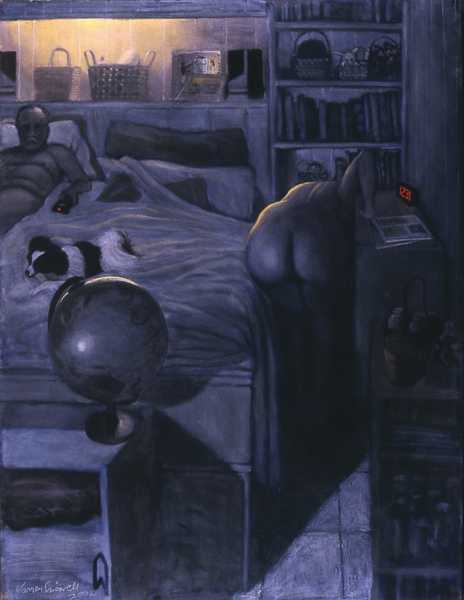 Blue Moon, 2002, oil on linen, 48 x 36 inches |
|||||
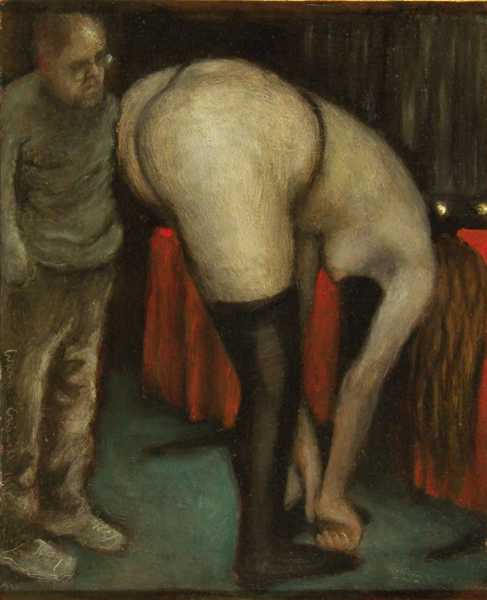
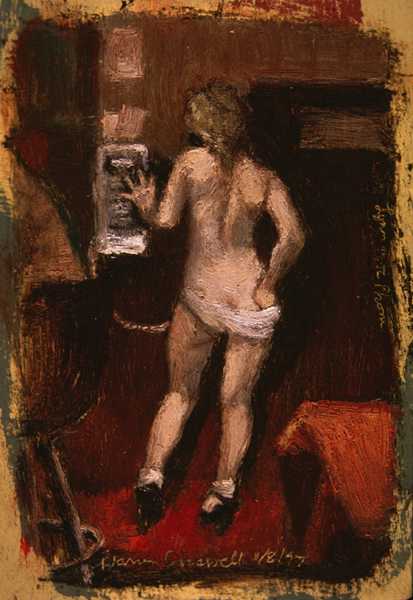
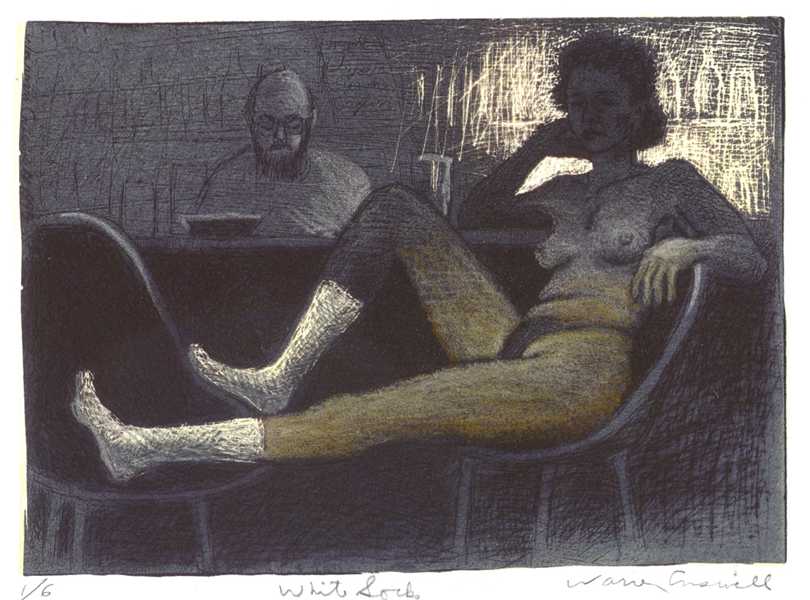
| Criswell's most naturalistic series of work to date is his least visually, but the most spiritually, anxious. Indeed, in the skewed dramas of its human interaction(s), it has at once informed and complemented the deft histrionics of the musically themed pictures. In fact, his many domestic interiors, nearly always featuring his wife Janet, and well as his paintings, drawings and prints of strippers, deliberately avoid the dramatic. Criswell suppresses all but the most glancing of incidents in his depiction of these profoundly "incidental" worlds. He has jokingly referred to himself as "the Degas of the strip joint," but unlike Degas, and after a good century of Freudian conditioning - and at least a quarter-century of feminist consciousness-raising - throughout western civilization, Criswell admits to his voyeuristic impulses. (But then, voyeurism as an artistic fundament is not the presumption it was in Degas' day.) What motivates Criswell on the quotidian level is the ambience of strip clubs, their slack, ordinary sordidness, and the contrast in attitude (as well as form) between the patrons and the performers. The behavior of the women ranges from vague enticement to matter-of-fact ennui - serving if anything to point away from their sexualized presence - while the men, responding even more to the pseudo-intimate atmosphere, perform the rigors and supplications of their status as sex-customers with sad discomfort or embarrassed intensity. |
|
||||
|
In the stripper series Criswell would seem to be indicting his own voyeurism by including depictions of himself among the (most abashed and furtive) men. Perhaps, but Criswell is a frequent presence in his pictures of all kinds and subjects. Narcissus-like, he dwells on his own visage, but not in admiration. He typically represents himself enduring or barely escaping improbable and/or dismal nightmare scenes (as when he's seen at night, perhaps in the rain, running - sometimes naked - down a rural highway, or getting the third degree from an interrogator who also has his face, or in the thrall of some lurid celebration, at best as one of many participants, at worst as the bacchanal's hapless Pentheus or Diana's doomed admirer, Acteon).
|
|||||
|
|||||
|
The exhibition catalog, Warren Criswell Shadows, in which this essay appears is Copyright 2003 by the Arkansas Arts Center
|
|||||