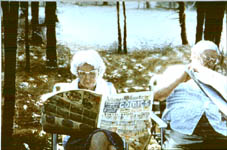
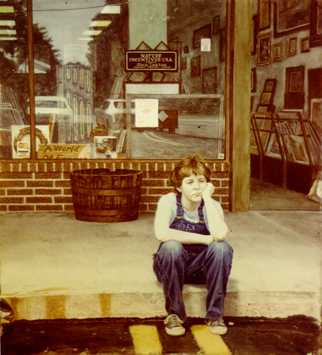
For Professor Kuspit I'm grim and sinister, while Mr. Cullum thinks I'm a comedian! I accept both laurels with gratitude. I just wanted to show how two people looking at the same thing can see something entirely different, which is as it should be. We can see a work of art only through the windows of our own lives. Don't get me wrong, I enjoy nothing more than raving on about the literary or musical sources of my images. I'm just afraid that doing so might derail the viewer's own personal approach to the work, because people usually make the mistake of assuming that an artist is the best authority on his or her work. Still, having said all that, I can talk a little about some of the circumstances which may have influenced the visual themes I mentioned above. I'm from West Palm Beach, so I guess that explains the ocean. In the late '70s when I painted Sunday at Yogi's I was discovering how the world actually looked. It was like I was experiencing my own personal Renaissance. |
|||
|
CLICK IMAGES TO ENLARGE
|
In the '60s, when I lived in Florida, my paintings were expressionistic
and strongly influenced by the work Richard Diebenkorn and David
Park were doing in California at the time, and also by deKooning
and Pollock. But then I dropped out of the art world and tried
to satisfy my creative urges by writing for the next 15 years,
the last five of which were spent on a dry-land Odyssey around
the USA in an old bus with my wife and two daughters. That explains
the highways. The last place the bus broke down was Little Rock, Arkansas, so we settled down here and for some reason I began to paint again. Actually, during the last few years on the road I had been feeling the tug of visual art like a salmon returning to the spawning beds. But now instead of the opaque oils I had used in Florida I started teaching myself the technique of transparent watercolor. And in place of my former expressionistic style I became a photorealist. As you can see from Sunday at Yogi's and Reflections, I was a watercolor purist, fanatically refusing to use any opaque white. The girl in Reflections is the daughter of my first Little Rock art dealers, Helen and Norman Scott, and Yogi's is the name of a campground we were staying in at the time. The man and woman are my wife's parents who were visiting us. But often it was almost as if the subject matter wasn't that important to me. It was an exploration of the visible world and often I would just point and click my camera at random. I thought more about abstract composition and visual effects than about who or what I was painting. But by the late '80s, when I did the large pastel Moths (1988), my work had darkened. Instead of my watercolor technique of working from light to dark, I began using pastels, sometimes in combination with oils, working from dark to light. The mood of the work darkened, too. The sunny landscapes of the watercolors were replace by a nocturnal world of street people in alleys and under bridges. |
||
| I had always figured that's how I would end up, so I identified with my subjects. I had to travel light, so I put away the camera and started stalking my subjects with a pocket sketchbook. An important thing about the watercolors was that my own image rarely appeared in them. As a writer I had worked for years on a failed autobiographical novel and was sick to death of myself. But now, almost unconsciously, I would sometimes put my own face on a wino. Maybe the culmination of these pictures is the oil on paper Two Men on Stilts (1991), but there are many echoes of it later, such as A Man Reading (1995). | |||
 |
 |
||
|
Title Page, Copyright, Installation Views, Page 1, 2, 3, 4, 5, 6, 7, 8, 9, 10, More Installation Views, Index Contact
Warren Criswell All images and text on this Web site |
|||