|
||||
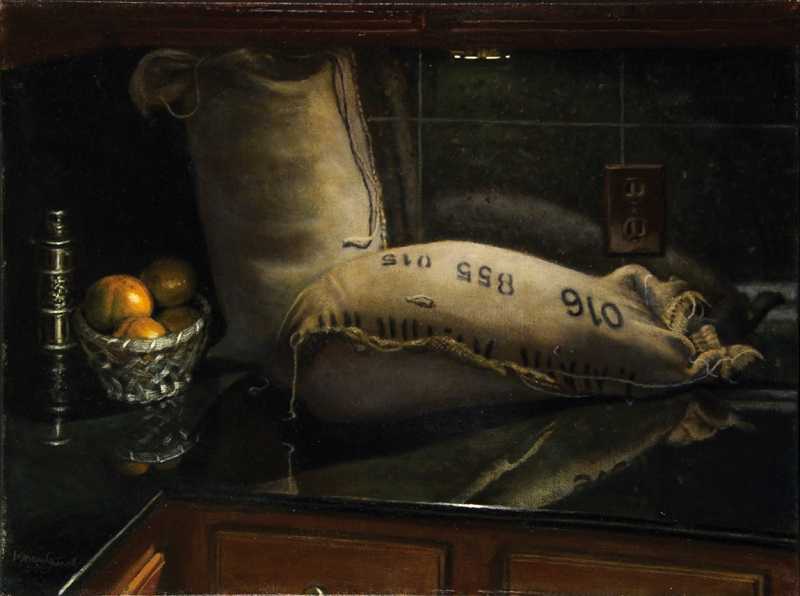 Coffee, a Warren Criswell work completed this year. |
||||
|
If you
want to know what Warren Criswell means by a painting, then perhaps
you should ask him yourself. He is not so hard to find and, if
you know his paintings (or prints or sculptures), then you likely
know what he looks like. Or perhaps you should keep quiet and
look - the art being infinitely more reliable than the artist. |
||||
| It is rare that an artist gets
so much attention, but it's not the first time Criswell has had
concurrent shows. Part of this is no doubt due to what we might
call - if the term didn't have certain intimations of diminution
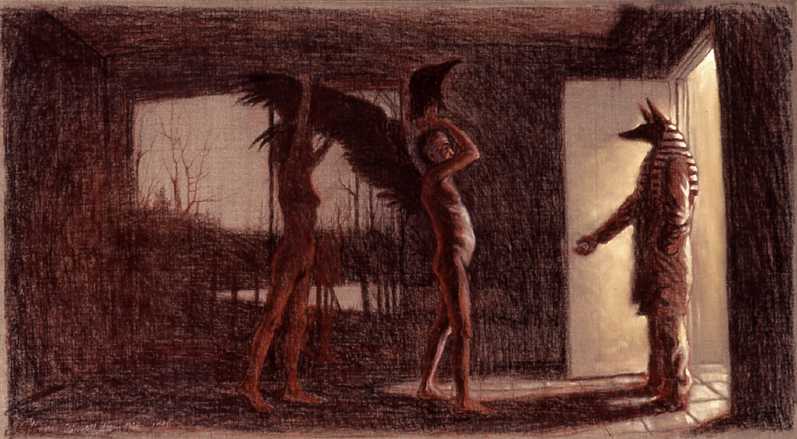
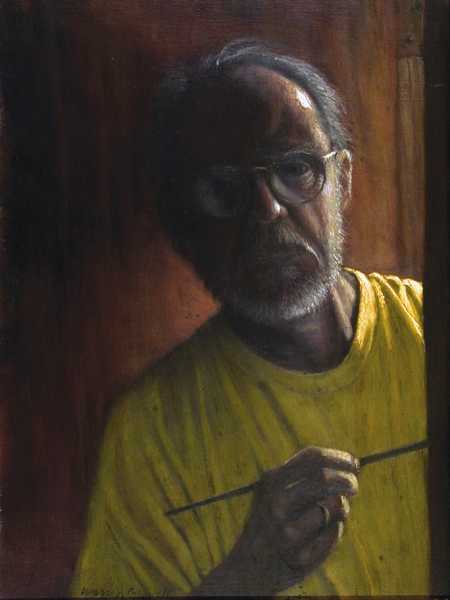
- the "accessibility" of his work. .What we mean by this is that one doesn't have to know much about art to appreciate Warren Criswell. When the man paints a figure, you generally recognize it as something from your experience: headlights on a highway at night, topless dancers in a blue-lit nightclub, an old guy running down the road - Criswell paints with the acuity and precision of a dead Dutchman. Another way to say this is to say his paintings look like photographs - impossible photographs to be sure, photographs of someone else's dreams and nightmares, but recognizable, unmistakable depictions of real world artifacts arrested in time. Criswell paints a shoe and you know immediately it's a shoe, rather than a splotch or color field. .Criswell isn't difficult in the sense that his "genius" - and we'll use that overused word here because it's applicable - is apparent in the same way Da Vinci's or Rembrandt's or Vermeer's is apparent (and will be so long as human eyes can behold them). They can be enjoyed by anyone - and anyone can be disturbed by them. But the "accessibility" of Criswell's work - the fact that no one could dismiss it by comparing it to their kid's scribbles - shouldn't be taken as an argument against any higher emotive complexity. Criswell is not painting what he sees - he is not copying photographs or trying to preserve a particularly beautiful, horrible or exotic tableau. (We don't "see" the world the way cameras render it anyway, we "see" with our minds more than our eyes.) .Still, one needn't resort to artspeak to describe Criswell's work, all one needs to do is look. This doesn't mean that artspeak isn't valuable; just that however erudite and perceptive the essays in the catalogs may be, they are written for an elite group of insiders - people who expect to contend with the sometimes circuitous constructions of an edge-walking critic seeking to explicate the work from the disadvantaged perspective of his own unreliable eyes. Though nonspeakers tend to view artspeak as a conspiracy of exclusion run on the rubes by the notalent dabblers and the insecure phonies who walk the galleries - a tongue in which it is quite easy to say much about nothing or nothing about much - those articles in artforum are not really so much jibber-jabber. .They are - or at least some of them are - a kind of dialogue between writer and artist, a working through of the writer's perception of the ideas the artist, who works in a language closer to the heart and the gut than the brain, has raised in his art. Sometimes the writer misperceives, sometimes the writer has trouble describing his perceptions, sometimes the art itself is junk. But artspeak is a kind of necessary evil when talking about the work of most artists. .It would be wrong to suggest Criswell is one of the few artists who can blast through the critical filter and speak directly to an audience; all good artists do that. It's just that with Criswell no one needs to be told what he's seeing, no one need feel intimidated by the details of the process. Criswell's process is invisible - only technicians look at his stuff and see brushstrokes and the brightening effects of lead white pigment. The rest of us see faces and ennui, the sad soft play of shadows in a desperate room at 4 a.m., a thousand anxious details caught in the interrogative flashlight of the first-person beholder. Often we see Criswell himself, satirized, caught doing something disturbing or in difficult straits. Who else could the figure rising by the roadside, swaddled in the Sunday edition of the Arkansas Gazette, caught in the beam of an onrushing headlight be but Criswell himself, the artist as smashable icon? (Oh, now we see - he's a "Chrysalis.") |
||||
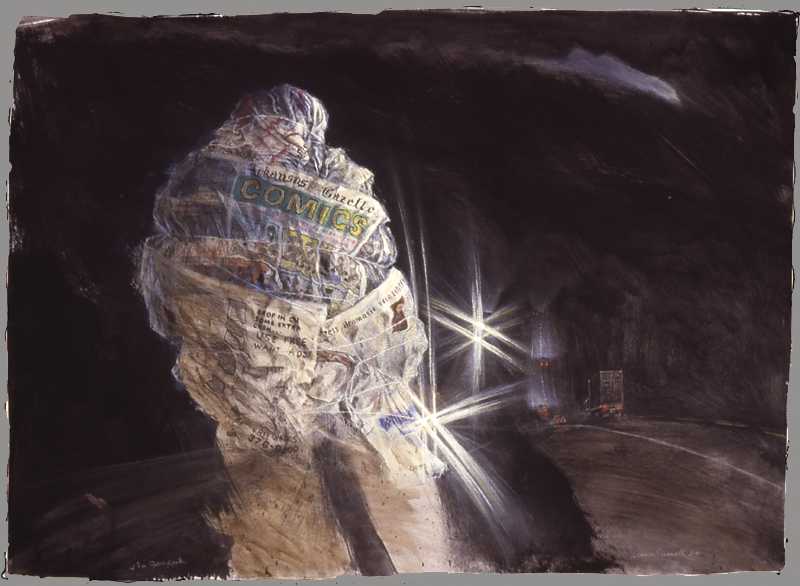 Warren Criswell's 1988 oil and pastel on paper, The Open Road. |
||||
|
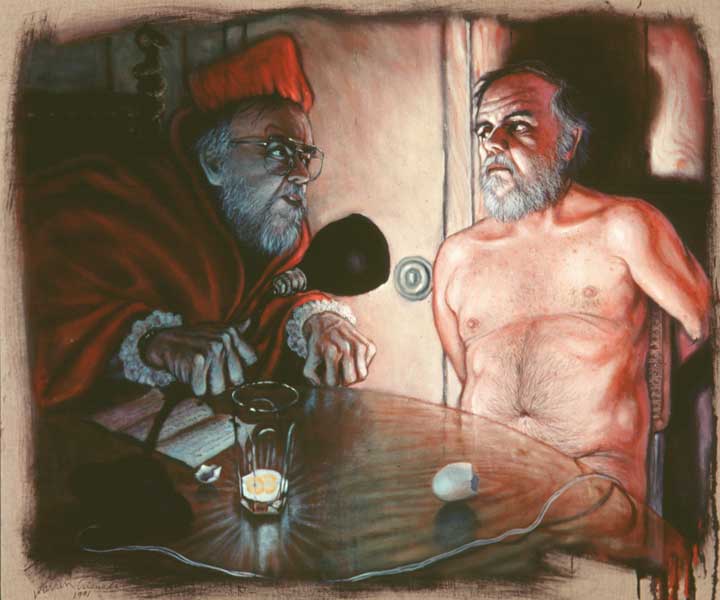 The
Question, 1991, oil on linen,
36 x 43 inches
The
Question, 1991, oil on linen,
36 x 43 inches Golem, 1997, oil & beeswax on plywood, 36 x 48 inches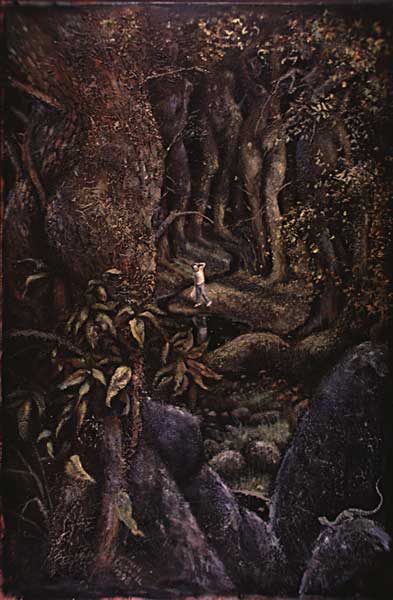
| (In the catalog
accompanying the Arts Center show, critic Peter Frank makes the
connection between Criswell and fellow "anxious realist"
Donald Roller Wilson, he of the mad partydressed apes). It is difficult to say; the artist is everywhere, grinning and grimacing, furtive in the shadows. If you catch him maybe he'll give up his secret. Or maybe you should just see. |
|||
Full disclosure: Philip Martin owns a Warren Criswell painting - Crow Unmasked - and hopes to acquire a couple more. E-mail : philip_martin@adg.ardemgaz.com |
|||
|
|||
|
All images and text on this Web site |
|||
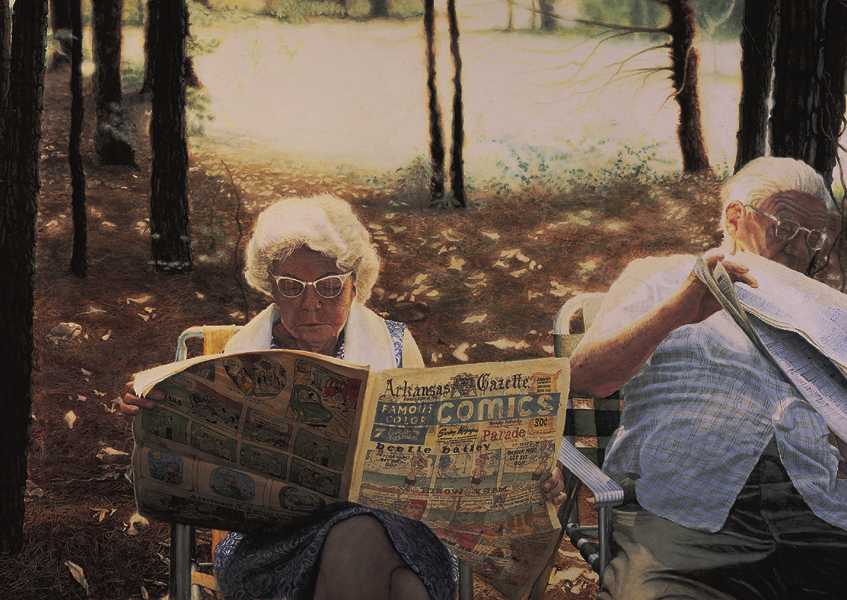 Sunday
at Yogi's, 1979, watercolor,
Sunday
at Yogi's, 1979, watercolor,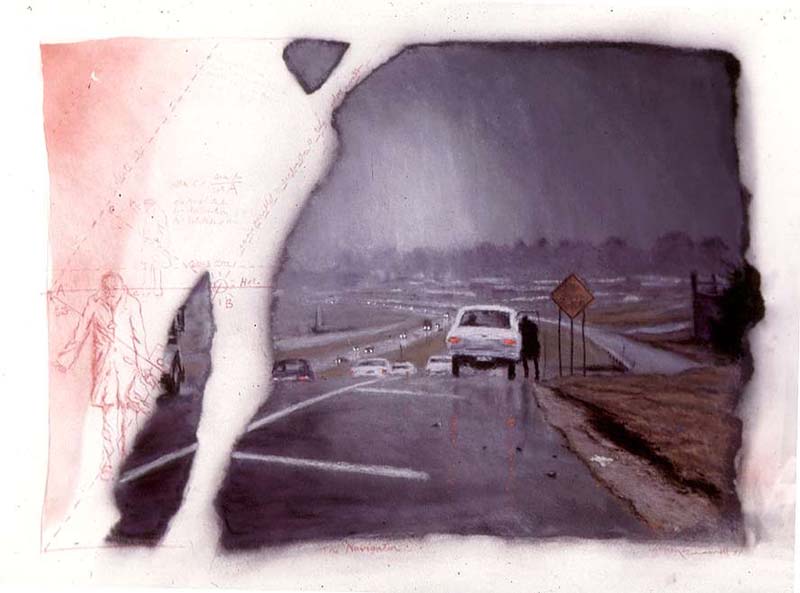 The
Navigator, 1987, pastel on paper,
The
Navigator, 1987, pastel on paper,